

 Sun, 16/06/2019 - 11:38 by
 Alison Joan Wilson
Jane sat on the seat at the top of the hill and wiped her brow, crossly. “They could have warned me it was so steep”, she muttered, as she waited until her breathing recovered.
She used the time to take in the view across to the distant moors, looking with more interest at the village that she’d just walked from, and which, from this distance, showed relatively few signs of the impact of the 21st century. Obviously, while some of the houses were modern, there was plenty of weathered red brick, as well as the local stone. Plenty of trees and hedges which hid the necessary signs of modern life such as power lines. Just for a moment, when she listened, all she could hear were the small birds chattering in the bushes next to her.
The sun was starting to break through the heavy grey sky that had followed her on the drive from the West Country the day before. It was dark when she’d checked in to the pub in the village that doubled as a B &B, so the promise of brighter skies was welcome. By the time she’d taken in the view and got her breath back, patches of sunlight were starting to reach her. She smiled, then got up and set off. Around the corner her destination came into view.
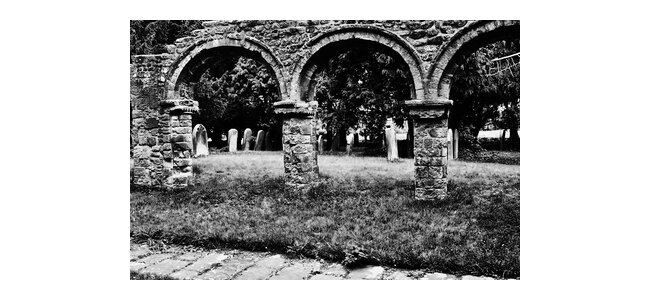
There had been a church on the site of the ruins ahead of her since the days when the area was invaded by the Normans, many centuries before. They were one of the few visible signs of settlements that had once surrounded it, before people moved to be nearer the stream in the village back down the hill. The combined effects of man, time and weather had resulted in the survival of only some stone arches, and a small chapel that was occasionally still used. From the gate at the roadside Jane walked up an avenue of ancient yew trees, trying to guess their age.
At the end of the avenue she paused to look up at the wooden door of the chapel. As she did so the first words of the verses that had been the reason for the visit came to her: ‘I sit, sun-dappled, sheltered by Norman arch’ – and there just to the left, was the place where she imagined the poet had sat and been inspired to write those words. In dappled sunshine she herself sat, lost in her own imaginings.
Time passed, and she became aware that she was not alone. In a way, that did not surprise her, given that she was surrounded by evidence of lives once lived. It was the appearance of the visitor who was watching her intensely some distance away that intrigued her.
A male figure, quite short, dressed in workman’s clothes from earlier times, was resting lazily on one of the tombstones. What was most startling about his appearance was his mane of hair – all shades of red, amber and brown – like a fox’s brush.
They continued to watch each other, and who knows how long they would have continued to do so had not the peace been shattered by the rumble of thunder. The blue sky had gone, unnoticed, and been replaced by dark grey storm clouds. Within minutes the heavens opened, and Jane was drenched. The chapel was locked, and she knew the risks of lightning strikes well enough not to shelter under the nearby beech trees.
But then, unexpectedly, the figure moved and beckoned her to follow him. As she did so another line of the poem came into her mind “…. one, named Henry Tod, Who died in 1759, sleeps here below”. He led her to the side of the chapel, and almost immediately she found herself falling, in darkness, coming to rest in a room hollowed out of the earth. It was bare, but dry and warm.
“You’ll dry off quickly enough in here” said the man, “and by the way, let me introduce myself, I’m Henry Tod, Esquire”.
She smiled. “I know, you couldn’t be anyone else”. She didn’t feel she could say that she knew that Tod was an old country word for fox, and he was very fox-like looking.
“How did you know that?” he asked.
She thought for a moment. “Well, it’s all in the poem. The poem that brought me to this place today. The description of a snapshot in time in this ancient churchyard. The thunderstorm isn’t in the poem, though.” Nor was meeting you, who died in 1759, she thought, disbelief vying with curiosity in her mind.
When there was a break in the thunder, Henry Tod asked her about the poem. She recalled that when she once worked for a publisher she’d found a collection of poems about English churchyards that had been collated but never published. This particular poem had stayed in her mind, and when retirement came she had tracked down the churchyard it was written about. It was one thing to recall this, but not so easy to explain to a man who had died 400 years previously, but she did her best.
When she had finished, and recited the full poem, Henry looked thoughtful. “Couldn’t have put it better myself.”
“I remember her”, he said. “You could tell she was a real country person and had a true faith in God. She was one of the few who looked after this place. Yes, there are those who come to view the gravestones of those gone before, maybe once a year, but never set foot on a place of God in between. She believed in the importance of both”, and he lapsed into a deep silence. Jane too, remained silent, feeling slightly guilty that she was one of those who visited her parents’ graves once a year, and never set foot in a church from one wedding, christening, funeral to the next.
Henry spoke again. “You know she’s here, don’t you?” Jane nodded. “Over in the new side. Haven’t seen her for a while. We don’t mix much, us and them, on the new side.”
Before Jane could think of a reply he continued “But she had a way with words, alright.”
After digesting this, Jane couldn’t resist asking him:” How come you talk to me, well, like I talk to you?”
“Oh, you’ll maybe find out one day, no need for you to know now,” was his non-committal reply.
As the noise of the storm outside continued, Henry talked. He told her that he’d been a skilled stonemason, and was part of the team renovating the church which had fallen into disuse and neglect. He was sheltering here during a thunderstorm like the one now, when lightning had struck, and he’d been killed instantly by a piece of falling stone. He wasn’t sure how old he was when he died, but thought he was perhaps in his thirties. He’d left a widow, and young daughter. They’d moved away soon after when his wife remarried.
Jane sat silently, listening, not daring to ask anything in case it broke the spell she was sure she was in – although there were so many questions she would like to have asked.
Then, almost as suddenly as it had started, the noise of the storm outside ceased, and Henry moved.
“Time for you to go back, now”, was all he said, and before Jane could ask “Will we meet again?” she was back at the side of the chapel.
She walked carefully round the old gravestones, trying and failing to make sense of what had just taken place. One thing was very clear: this was not for sharing with others.
She didn’t sit down by the arch, but turned and walked slowly into the ‘new’ part of the churchyard, towards the fence, where the newer tombstones were. As Henry had suggested, it didn’t take her long to find the poet’s grave. She sat down on the nearest seat. Out of her handbag she took a notepad and pen, and scribbled furiously, trying to record the conversations and experiences that had just taken place, before they were forgotten.
She stopped when she could write no more and her hand was stiff, noticing that she was cold. Stretching, she rose and walked slowly towards the gate, then back down the hill to the village.
The following day, when Jane retraced her steps, the sun didn’t shine: it was cold and windy. Too cold for anyone or anything to be out and about.
When Jane repeated the trip the following year, the sun came out just as it had on the first visit, when she sat by the arch. There was no thunderstorm and no Henry Tod, although this time she thought or could imagine she sensed his presence. The next day both the sun and any suggestion of another presence were absent.
As the years went by she managed to get back to the churchyard most years, and each time the sun came out when she sat by the arch. She never saw Henry Tod. The visits were important to her for reasons she didn’t understand. Attempts at finding out about Henry Tod drew a blank as parish records for the early 1700s are notoriously unreliable where they exist at all. When failing health put the trips in jeopardy she determined to go one last time.
It took some time to make the arrangements, but eventually Jane was dropped off at the gates to the churchyard, to walk slowly up the yew tree avenue on her own. Her driver had been given strict instructions not to come and find her, and that she, Jane, would message when she was ready to leave.
The churchyard looked the same as in other years. As she carefully lowered herself to sit by the arch, the sun came out and she relaxed into its warmth. Looking around carefully, she noticed that Henry Tod’s gravestone had been moved, and there were signs of fresh digging. While she was taking this in, Henry appeared, and beckoned her to come inside the chapel, the door of which was now open.
“I knew you were coming today”, he said. She didn’t ask how, but got up to follow him, with difficulty.
He seemed agitated.
“Things are going to change here”, he said, much to Jane’s surprise. “They say these grave stones aren’t safe. Safe!” He spat the words out angrily. “What do they know!”
He went on, “but time is short, and I must show you this” and moving to the back of the chapel, pulled aside a curtain. Jane entered and saw on a small table an open book. She looked at it intently, trying to make sense of the words.
“The poet had learned some of the old languages and could make sense of them. She became interested in me and followed the history of my wife through time. Three years after my death my wife remarried and had another child. The poet was descended from this child.” He paused, looking down at the book, then at Jane, who stared back at him, having a sudden premonition as to what he might say next. “You, Jane, are descended from my own daughter”.
Sometime later when the alarm was finally raised, they found Jane sitting by the still sun-dappled Norman arch, peaceful in her final sleep. Henry Tod’s gravestone had been replaced safely.
She was buried in the churchyard shortly after. In bright sunshine, and out of sight of everyone, Henry Tod watched and listened. The handful of mourners who’d made the journey also listened as the poem that linked Jane, the poet and Henry was read out to them when Jane’s body had been lowered into the grave. Then, as they made their way to their cars, they were startled by a deafening rumble of thunder, lightning flashed, and as the heavens opened, Henry Tod disappeared for the last time.
Reference
“In Whorlton Churchyard”, poem by Joan Hartley (1919-2015)
We will publish the poem which provided the setting for this story on 18/6/2019
Add new comment